
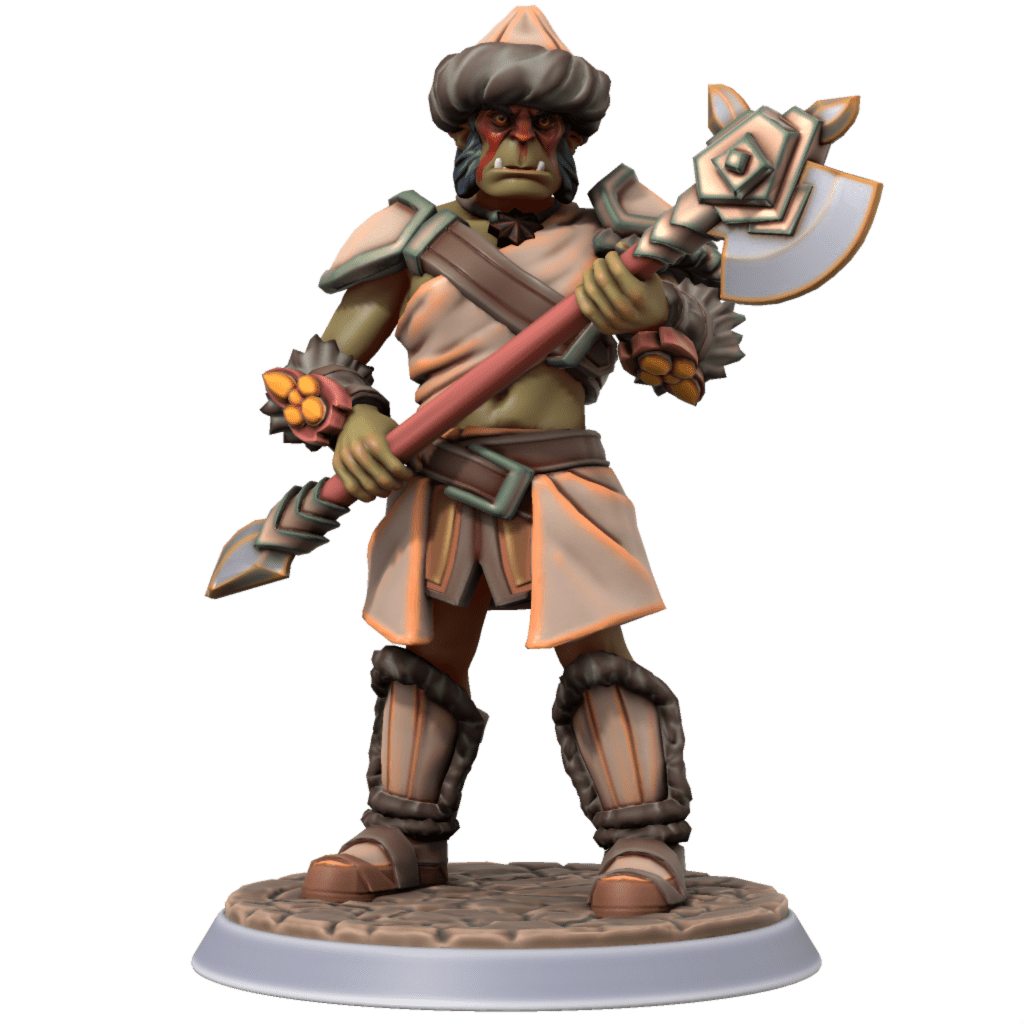
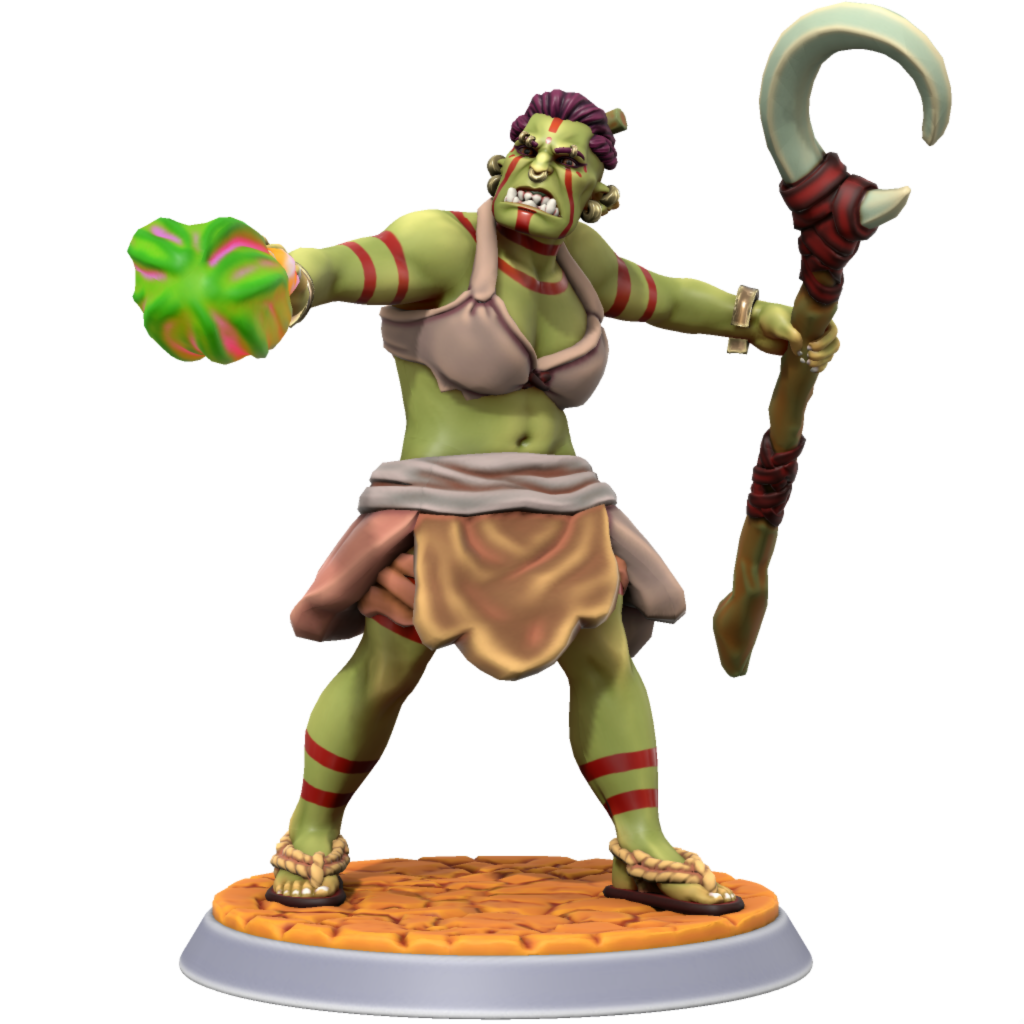
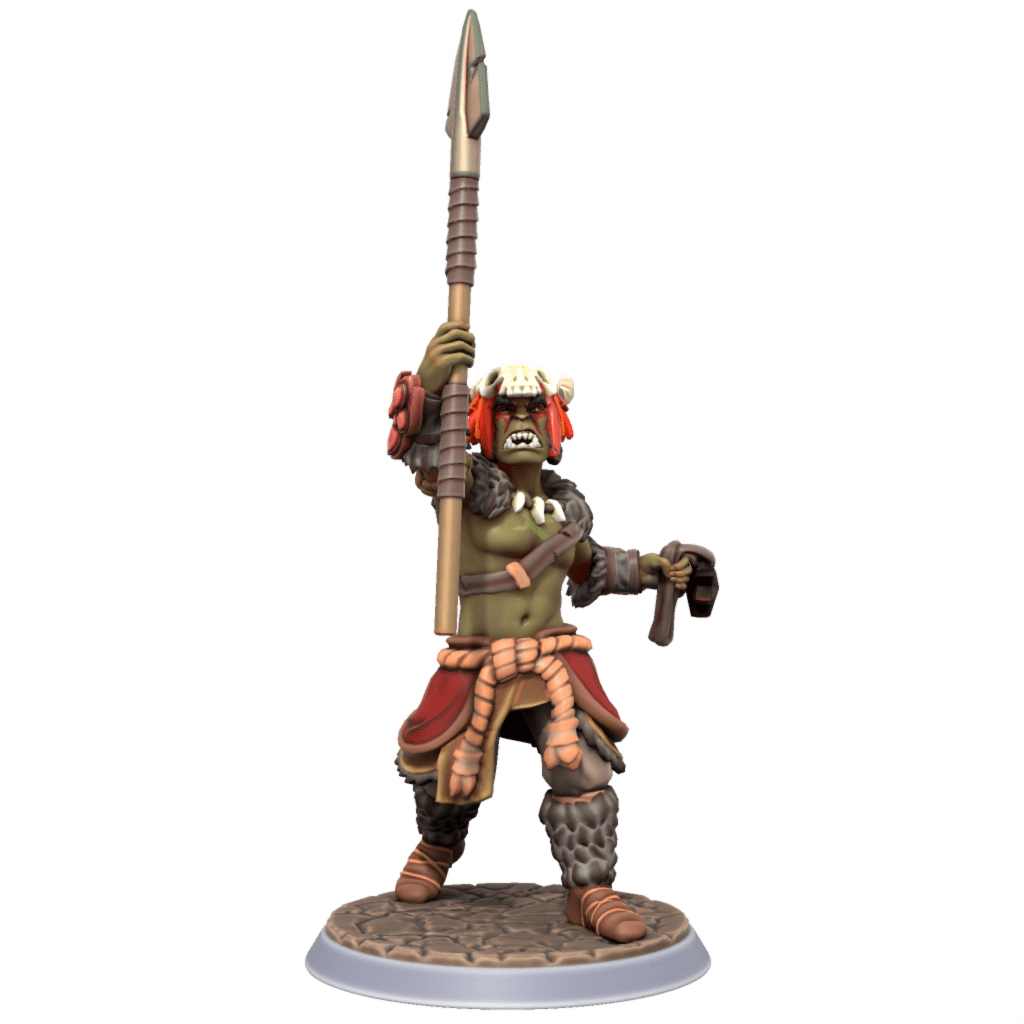
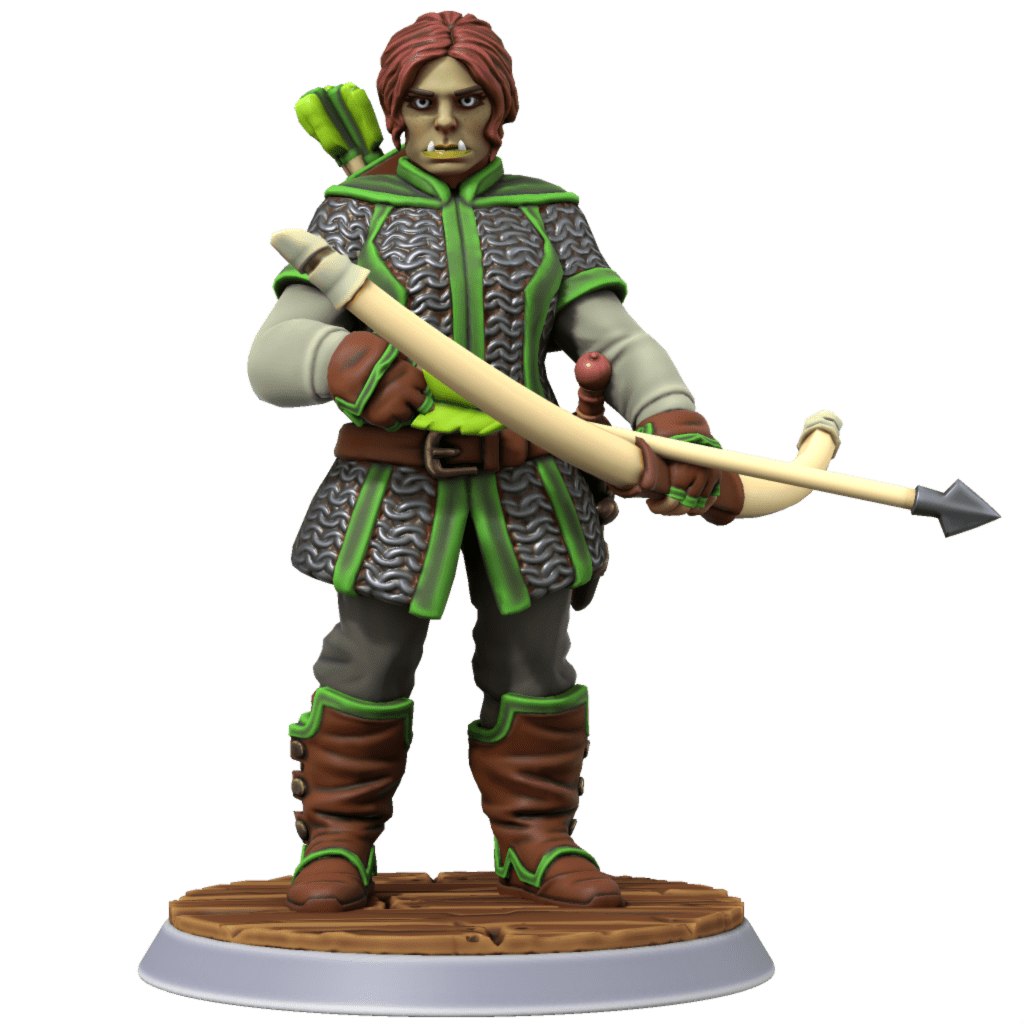
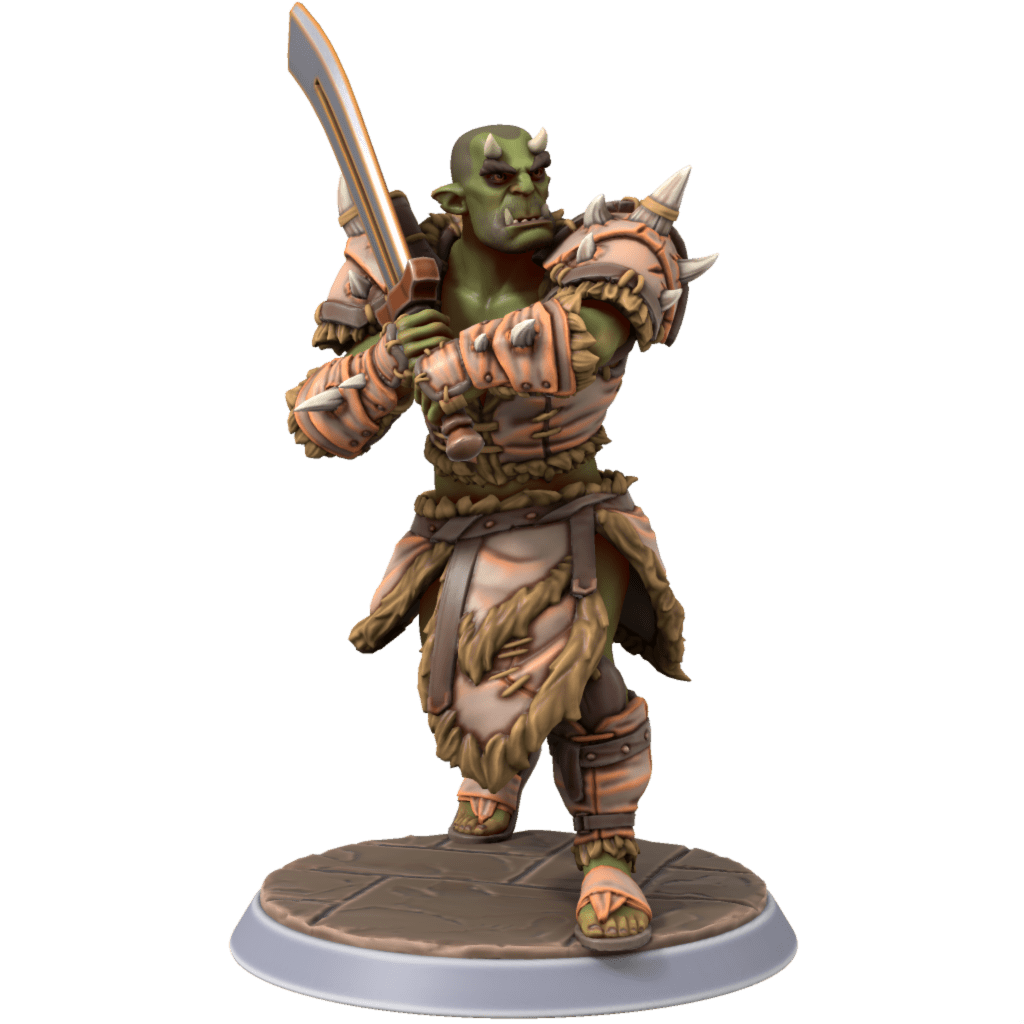
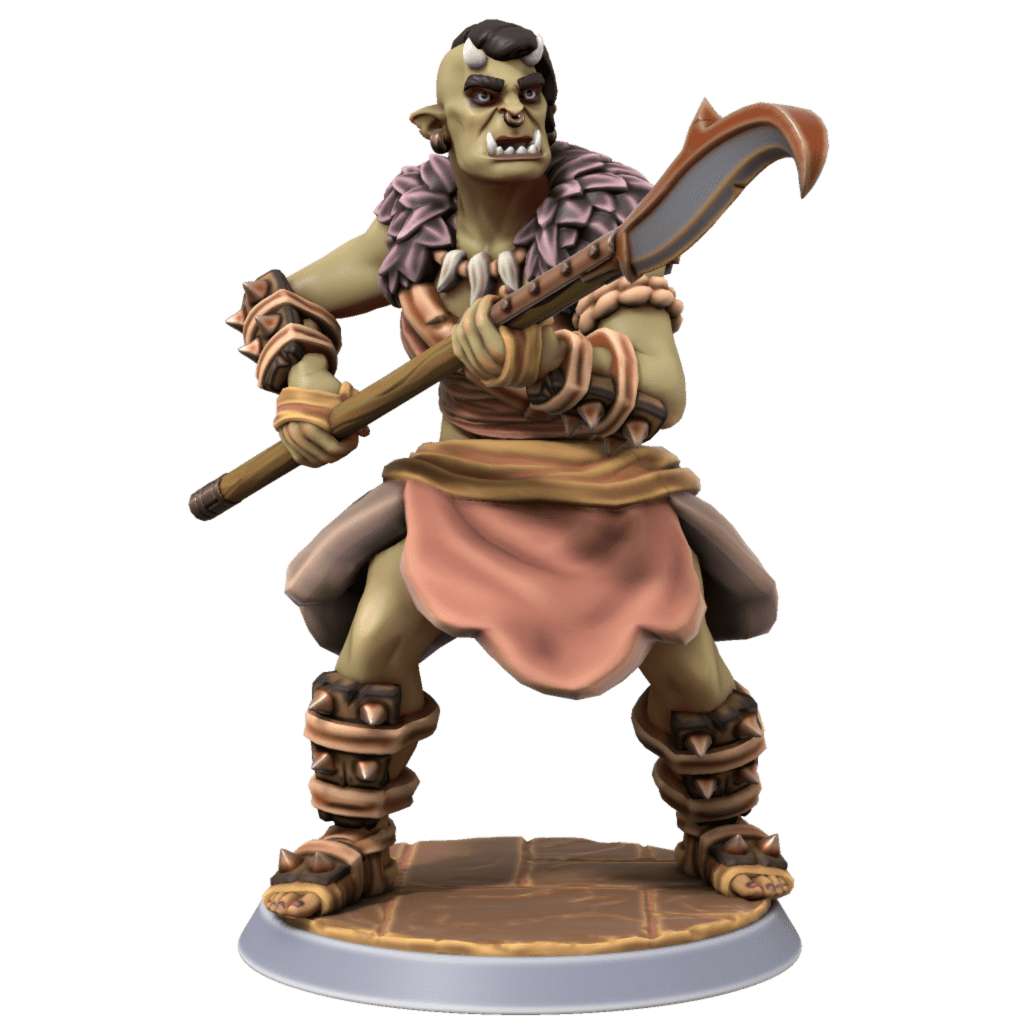
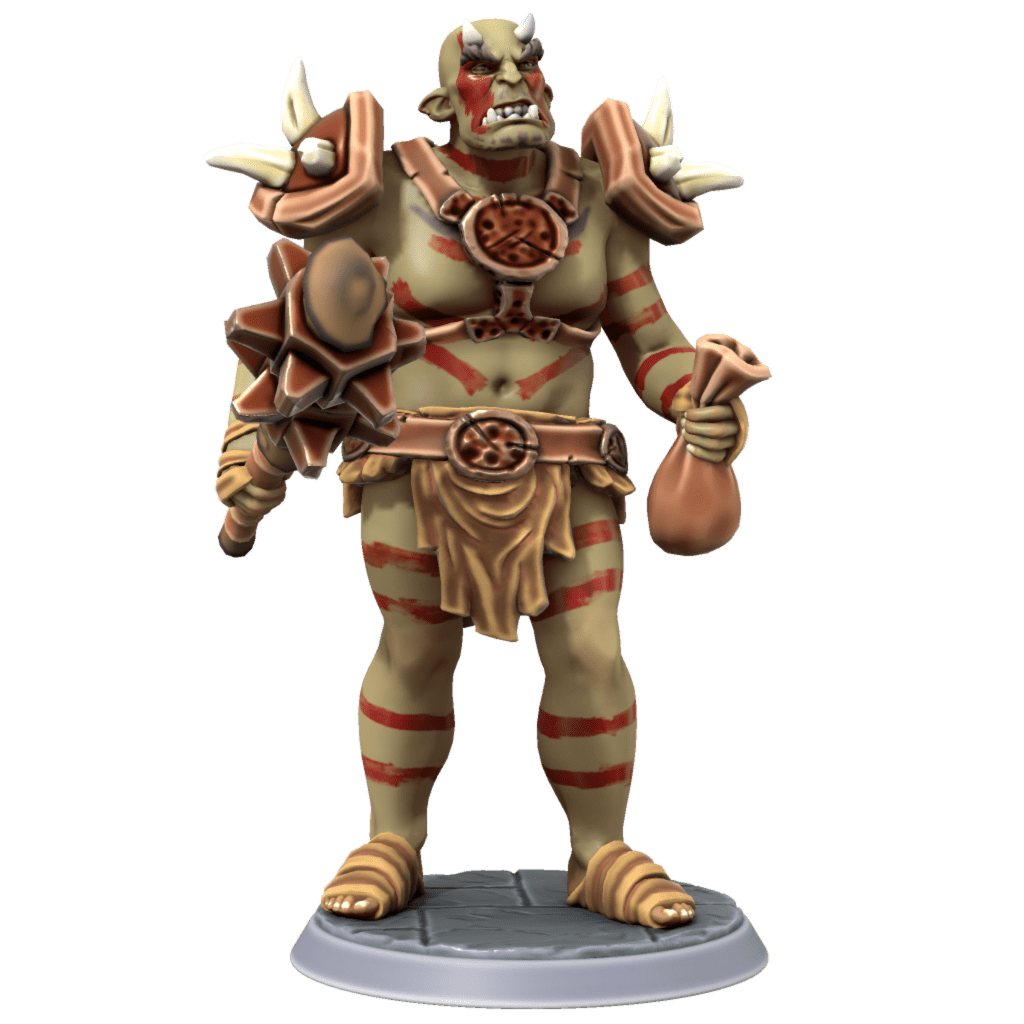
Orcs are one of the most formidable societies encountered in Iorth. Descendants of the ancient two-headed giant Urgk, from whom both orcs and ogres originate, the typical orc is taller and broader in build than an average human. They have strong jaws with a slight underbite, and the canine teeth are more pronounced and fang-like, with the lower canine teeth protruding from the lip in a tusk-like fashion. They have tough skin with green to olive complexions, coarse dark hair, and eyes that are amber, orange, or brown in color, but have black sclera. Traits such as light colored hair or blue, gray, or green eyes are deemed to be hints of human heritage.
Despite distance and culture, all orcs speak the Orcish language. However, this does not mean that orcs can necessarily clearly understand each other; orc dialects are vast and varied, as well as the amount of slang or informal style present in the language. The Orcish alphabet is rather basic, using a few letters paired with diacritics to indicate which sounds they represent. Generally, a letter for a consonant can represent the voiced and voiceless forms of that phoneme. In some instances, a diacritic may be used with the letter to indicate which precise sound is used, but not always (or consistently). Also, Orcish technically only has one letter that is a vowel, representing a schwa (ə) sound, which is then modified by a specific diacritic to indicate another vowel sound. However, which diacritic is used by which group of Orcish speakers can be a matter of preference, and therefore can cause a significant amount of confusion. This, combined with the propensity for new terms and concepts to be crudely adapted from various other languages in order to add the concept to the language, makes Orcish a relatively easy language to learn initially, but a challenging language to master.
Though related to orcs, ogres and ettins do not speak Orcish as a first language; their native tongue is actually a crude form of the Giant language, with a simplistic variety of the runes used in Dwarvish and Giant for some semblance of a written language.
Unfortunately, many orc societies are controlled by oppressive warmongering cults that syncretize orc identity and culture with violence, terror, and cruelty. Orc societies that do not have these cults are more stoic and reserved in general, and frequently strive to maintain their independence from the cult-corrupted orc societies. This influence occurred early in the development of orc society.
A majority of orc and ogre communities are semi-nomadic groups who dwell in environments challenging to survive in. This situation encourages competitive and aggressive behavior and outlooks on life. As such, orc communities are more prone to feud and raid one another due to scarcity of resources or perceived power and dominance over other groups. It is this aspect of orc society that gets exploited by cults and cruel faiths like Path of Darkness to compel these societies to accept and even celebrate cruelty and immorality, much less consider it an inherent aspect of their identities.
Because of this, endeavors such as industry and agriculture are not often pursued by orc communities. Many groups of orcs prefer to raid rivals or non-orc settlements to obtain necessary food, tools, resources, and supplies. Some of these groups will spare some of the victims, thinking that they will simply rebuild to a point where the orcs may raid them once again. Other groups simply slaughter everyone, thinking that doing so is a keen precautionary measure to prevent any survivors from mounting a counterattack or seeking revenge. The idea and existence of an orc nation is a new concept, and it only came about due to the unique abilities of a notable leader combined with an unique opportunity to obtain territory of their own. Orc methods of industry and agriculture derive largely from ideas used by several other cultures that have been adapted for their community’s specific needs.
Beside raiding, orcs tend to hunt or forage for food. Most food orcs eat is mixed fare that can be easily found in the region they are in at the time; for example, an orc community in a wetland will often hunt frogs, fish, or reptiles for sustenance. However, whether obtained by hunting or raiding, several orc communities have shown a fondness for swine and peccaries. These groups have roving herds that travel with them, or frequent hunting grounds known for wild boar. Orcs value items crafted with pig leather or bone as well. Orc males refer to themselves as “boars,” while females call themselves “sows.” Some orcs raise large, aggressive swine for war mounts or guard beasts, or in a few rare instances, pets. And, coincidentally, orcs are the most likely to be around and potentially become wereboars.
As noted previously, most orc communities are semi-nomadic in nature, often traveling to forage edible plant fare and hunt game, and then sheltering in a protected area with permanent shelter during disastrous weather events or harsh seasons. Typically, this would be an area with natural caves and access to water not too far away, but also somewhere that provides natural fortifications or could easily accommodate some form of purpose-built crafted defenses (such as a combination of earthworks and stockades). While roving the countryside, orcs usually have simple tents, most often a tarp made of hide or looted textile, frequently staked at one end of the sheet and held up at an angle by two poles at the other end of the sheet. Many orcs will pitch their tents in a ring or enclosed configuration so that they all face a central fire pit. This formation is meant to shelter the fire from wind, but also to effectively use scant fuel for the fire by as many as viable. There is no general pattern to the arrangement of tents for the campsite, except for one particular detail: the middle of the encampment would have the main fire pit for the group, as well as the larger tent where the leader and their retinue would shelter.
Orcs that have permanently settled in an area tend to construct stout, sturdy shelters in which an entire family may reside. Many orc buildings are single-story structures, built as a single giant room with a central fire pit. Some more elaborate residences may have smaller rooms off of the main central chamber, but the premise remains the same. In orc settlements, there is no delineation between businesses and residences; most merchants simply set up a stall or awning outside of their residence and conduct their business or perform their trade there. The only other types of buildings in an orc community serve a clear and practical purpose: storage, fortification, worship, or livestock shelter. At the center of the settlement, just as with the roving group encampments, is a large communal fire pit and the (often fortified) residences of the community leaders.
Orcs value practicality and independence, and this attitude extends toward arms and armor. In general, orcs prefer the use of axes as weapons, due to their utility as a tool and weapon of war. Furthermore, orcs prefer spears as hand and ranged weapons due to their use for hunting and for war, and since they are durable enough for multiple uses, unlike arrows or bolts that may be ruined after one use. Single-edged knives are used as personal defense weapons, but also serve as a tool and eating utensil. Blunt weapons like clubs and greatclubs are valued for both their effectiveness but also their low maintenance. Most orc armor of their own make is hide armor, though they will use armor taken in a raid if it is available. However, one key element of the armor is that it should not require help to put on or take off; armor that does require assistance to equip or remove is often reserved for leaders, who have members of their retinue assist in the process. Weapons such as swords or crossbows are impressive to orcs, but the degree of maintenance for those weapons make them items reserved for individuals of prominent status within the group. (As it is, it takes less time to sharpen the edge of a knife or axe than it would the longer blade of a sword, much less a double-edged sword blade; practicality is key.) Shields are simple in form, often made with a single central grip in the middle rather than having it strapped to the arm; orcs are fond of striking with a shield in combat.
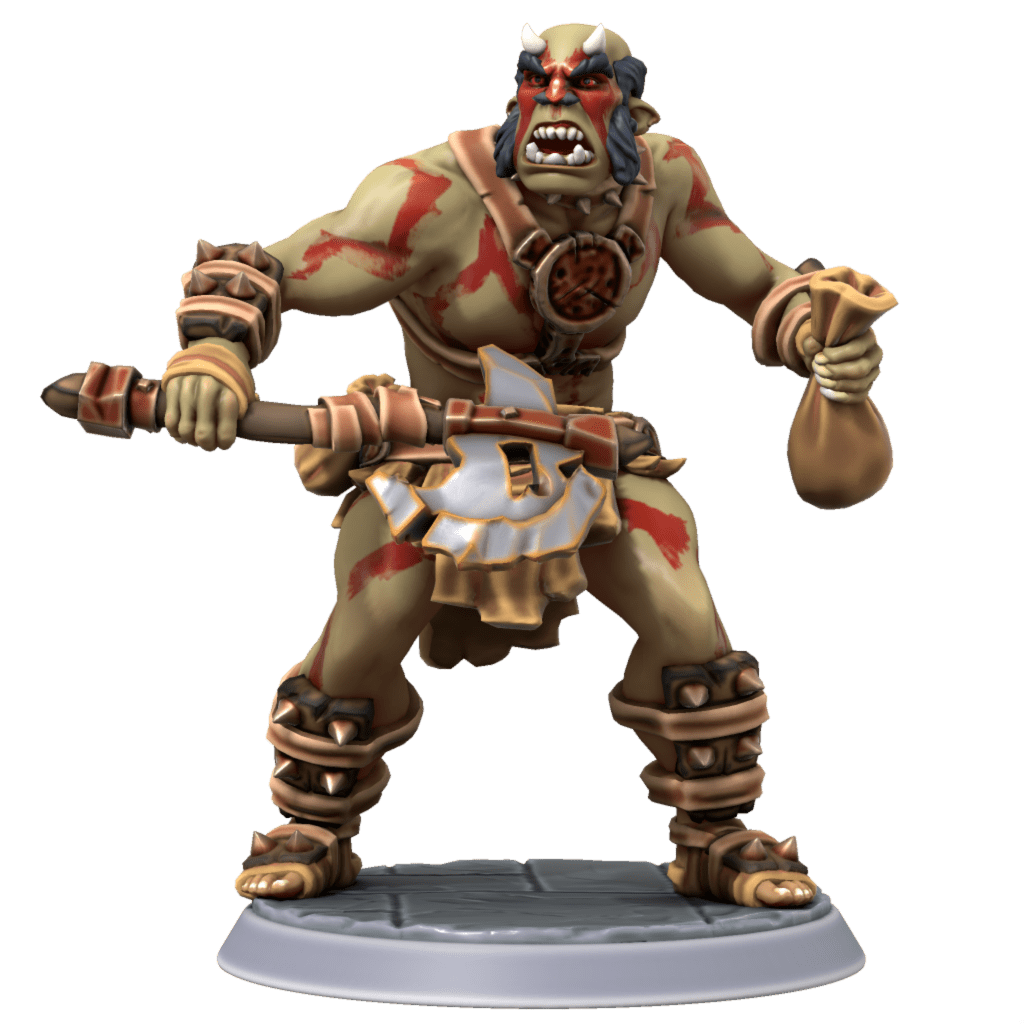
Though often encountered independently of orcs, both ogres and ettins frequently associate with orc groups. Ogres appear to be a giant version of an orc, ranging between 9 to 10 in height, though their complexions are sometimes ochre rather than greenish. Furthermore, ogres have small horns erupting above their eyebrows. Ettins seem to be slightly larger, stronger, two-headed versions of ogres. Both ogres and ettins are normally solitary sorts, but many individuals easily incorporate themselves into orc communities, often in the role of protectors, enforcers, or even leaders for those groups who embrace a “might makes right” worldview.
Legends tell that Ur, god of the underworld, darkness, and chaos, created a two-headed giant known as Urgk in response to the creation of humans by the god An. Ur was said to want a people that were strong, dominant, and aggressive, capable of overtaking any of the other mortal beings present on Iorth. However, according to legend, Urgk (whose name meant “get of Ur”), decided to attack Ur in order to dominate the god and take his power. Ur then struck Urgk with his spear, splitting the giant down the middle and sundering his creation into two different peoples: the orcs and the ogres. This legend is used to explain the frequent association between orcs and ogres, though none truly know the reason why. (This legend also hints at the origins of ettins as well, which appear to be a larger two-headed variety of ogre.)
While other peoples and cultures started to move away from worshiping demigods to embracing a religious philosophy, a warrior-priest of mixed orc and ogre heritage named Orkus espoused a new belief system. This faith was a religious philosophy like the Path of Light or the Path of Awareness, but it rejected the values those faiths endorsed and instead embraced the opposite, even making an unholy pact with the god Ur in the process. As such, Orkus is known as the first priest of the Path of Darkness. Orkus grew in such power and prestige that almost all orc and ogre communities embraced his religion. What is known is that Orkus committed such an unholy, cruel, and blasphemous act as a final rite before his death that pleased Ur. As a reward for his achievements, Orkus was turned into a powerful demon. Most mortals, including orcs and ogres, know of Orkus as a mortal who became a demon, but not of his creation and spread of the Path of Darkness.
Orcs are remarkably fertile, and large families are seen as desirable in the community. Furthermore, a maturing orc’s desire to breed is a strong impulse, and in many cases simply physical compatibility is the only requirement sought in a partner. As such, this leads to frequent pairings between orcs and ogres, as well as between orcs and goblins, and even orcs and humans. These unions do yield offspring, though two varieties are most often encountered: orcans and ogrillons.
In regions where humans and orcs frequently interact, it is not uncommon for there to be occasional unions between the two, producing children of mixed heritage. They are called “half-orcs” by many humans and “half-humans” by many orcs, but they call themselves orcans (a portmanteau of orc and human). Orcans have builds between that of a human and an orc, and a complexion that favors the orc parent, but paler overall. The orcans have tusk-like fangs for their lower canine teeth, and a slight underbite as well, though their facial proportions are more like those of a human than an orc. Though a orcan’s eyes resemble an orc’s, they may have as broad of range of color as those of a human.
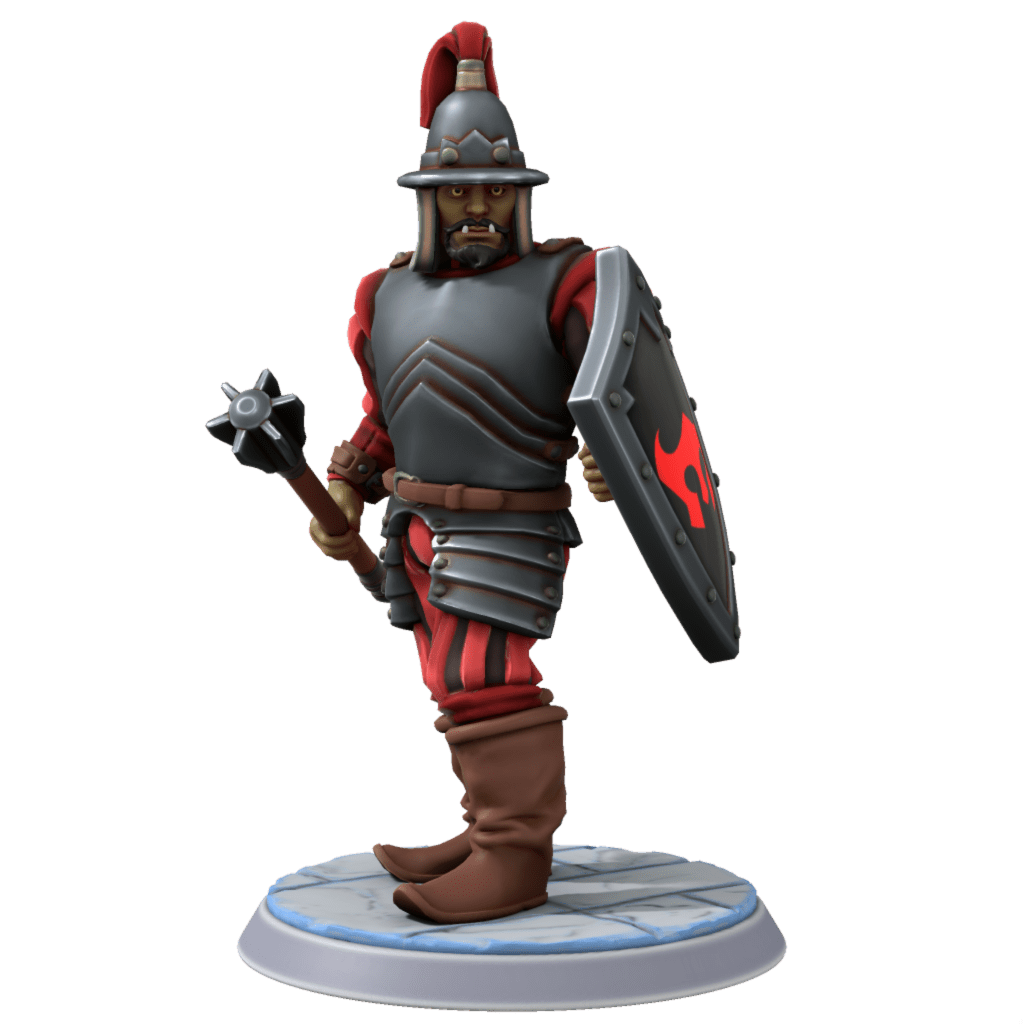
Ogres are related to orcs, and in many instances, ogres and orcs will interbreed and produce offspring. These ogrillons, as the humans call them, tend to be larger than orcs, but smaller than typical ogres. They have complexions that favor the ogre parent, and in addition to the strong jaw and the tusk-like lower canine teeth, ogrillons have a small short horn over each eyebrow, like their ogre parent. Many ogrillons tend to stay in orc communities, fulfilling roles such as enforcers or bodyguards for prominent orcs. Those few ogrillons of human-ogre pairings tend to be more violent and aggressive overall, mainly due to the need to “prove” themselves within an orc community.
Orcs treat orcans and ogrillons no differently than full-blooded orcs, though some human communities may have difficulties including orcans. It is likely that either parent will raise a orcan, instilling the values of their communities within the child. It can be noted that orcans raised by orcs tend to be more assertive and aggressive, due to the nature of many of their communities, while human-raised orcans have demeanors as varied and refined as any of those found in any human community. This disparity is often due to the dominance of oppressive warmongering cults dominating many orc societies that syncretize orc identity and culture with violence, terror, and cruelty.
While many other societies do not have a positive outlook on orcs and their kindred, this phenomena is due to the overwhelming presence and influence of the Path of Darkness in many orc societies. Those orcs who develop without the influence of the Path of Darkness are stoic, hard-working, brave, and practical folk who simply want to live quietly, rather than have to concern themselves with conflict and conquest the entirety of their lives.
Gallery
 Iorthbound