A calendar year in Iorth consists of 364 days, divided up into 13 months. Each month consists of 4 weeks, with each week being 7 days long. The actual solar year of Iorth is exactly 364 days long. The lunar cycles of Iorth’s moon are exactly 28 days long. The actual order of days, length of months, and other elements of the calendar remains constant throughout the ages, due to the unique length of Iorth’s solar year and lunar cycles.
The names of the days are based on the elements and the divine, whereas the names of the months are based on the astrological sign visible that month. Each season lasts exactly 91 days.
The days of the week are, in order:
- Godsday: typically reserved as a day of worship and spiritual reflection. The first day of each season happens to fall on a Godsday.
- Fireday: the old day of worship for the fire titans.
- Waterday: the old day of worship for the water titans.
- Treeday: the middle of the week, and viewed as a day auspicious for discovery and finding answers.
- Airday: the old day of worship for the air titans.
- Earthday: the old day of worship for the earth titans.
- Coinday: typically appointed as the day of paying debts or wages. Also treated as a day of rest and enjoyment.

As mentioned previously, the names of the months of the year are based on the dominant constellation. Each month consists of 4 weeks of 7 days each. The months of the year are:
- Hawkmoon
- Nymphmoon
- Frogmoon
- Wolfmoon
- Griffmoon
- Rammoon
- Owlmoon
- Trollmoon
- Elkmoon
- Catmoon
- Drakemoon
- Bearmoon
- Swordmoon

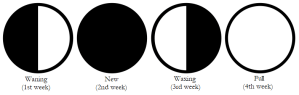
The phases of the moon, Muin, are regular and follow a predictable progression.
- A third quarter moon appears on the 1st of each month.
- A new moon appears on the 8th of each month.
- A first quarter moon appears on the 15th of each month.
- A full moon appears on the 22nd of each month.
Holidays and Observances
Notable holidays and festival days in the northern realms include:
- Newyear: (Godsday, 1 Hawkmoon) The spring equinox is also considered the first day of a new year.
- Midspring: (Treeday, 18 Nymphmoon) The middle of the spring season.
- Suneve: (Coinday, 7 Wolfmoon) The last day of spring.
- Sunday: (Godsday, 8 Wolfmoon) The summer solstice.
- Midsummer: (Treeday, 25 Griffmoon) The middle of the summer season.
- Mideve: (Coinday, 14 Owlmoon) The last day of summer.
- Midyear: (Godsday, 15 Owlmoon) The autumn equinox is the first day of the second half of the year.
- Midautumn: (Treeday, 4 Elkmoon) The middle of the autumn season.
- Mooneve: (Coinday, 21 Catmoon) The last day of autumn.
- Moonday: (Godsday, 22 Catmoon) The winter solstice.
- Midwinter: (Treeday, 11 Bearmoon) The middle of the winter season.
- Endyear: (Coinday, 28 Swordmoon) The last day of winter is also considered the last day of the current year.
Calendars in Iorth
Rather than being a mutable, changing item as it is on Earth, the device known as a calendar in Iorth is often a simple object made of a durable material, such as wood, metal, or stone (though some cloth calendars are made and used).
The purpose of these calendars are not to record the days, but to map out the days of a year to assist in planning and record-keeping. Everyone knows that the 14th of any month will be a Coinday, and that the 14th of Owlmoon is the holiday known as Mideve (or the last day of summer). However, recording what occurs, or marking instances that one may wish to remember, is where a calendar becomes useful.
The calendar has 13 tables—1 for each month—laying out the 28 days of the month in a grid. More detained or extensive calendars will indicate the phase of the moon on each day, and will have calculated astrological events such as the appearance of a planet or an eclipse.
| Godsday | Fireday | Waterday | Treeday | Airday | Earthday | Coinday |
| 1 | 2 | 3 | 4 | 5 | 6 | 7 |
| 8 | 9 | 10 | 11 | 12 | 13 | 14 |
| 15 | 16 | 17 | 18 | 19 | 20 | 21 |
| 22 | 23 | 24 | 25 | 26 | 27 | 28 |
The Year in the Southern Realms
The order of the seasons are reversed in the southern hemisphere, but the lunar cycle remains the same. For example, the summer solstice has a full moon, which is seen as the “dominance” of light during that time of year. The winter solstice has a new moon, which is seen as the “dominance” of darkness during that time of year. Both equinoxes are deemed as a time of cosmic balance. The realms of the southern hemisphere have their own holidays and observances that correspond with holidays in the northern hemisphere, though with some differences. The months remain the same, however, due to their astrological connection.
Notable holidays and festival days in the southern realms include:
- Newrule: (Godsday, 1 Hawkmoon) The autumn equinox is also considered the first day of a new year.
- Harvest Festival: (Treeday, 18 Nymphmoon) The middle of the autumn season.
- Eve of Shadow: (Coinday, 7 Wolfmoon) The last day of autumn.
- Festival of Darkness: (Godsday, 8 Wolfmoon) The winter solstice.
- Ice Festival: (Treeday, 25 Griffmoon) The middle of the winter season.
- Eve of Maidens: (Coinday, 14 Owlmoon) The last day of winter.
- Festival of Union: (Godsday, 15 Owlmoon) The spring equinox is the first day of the second half of the year.
- Planting Festival: (Treeday, 4 Elkmoon) The middle of the spring season.
- Eve of Light: (Coinday, 21 Catmoon) The last day of spring.
- Festival of Light: (Godsday, 22 Catmoon) The summer solstice.
- Flame Festival: (Treeday, 11 Bearmoon) The middle of the summer season.
- Endrule: (Coinday, 28 Swordmoon) The last day of summer is also considered the last day of the current year.
 Iorthbound