Category: Miscellania

Early Iorth, ala Old School Essentials

The world of Iorth is an evolving place, changing and developing over time like any other world. However, the most notable changes to the realm are due to epic adventures and grand schemes, which have shaken the foundations of the world to its core time and again.

In an obvious sense, these changes reflect the rule changes of the role-playing game system transitioning from edition to edition, or even from game system to game system. While each group may wish to use whichever game system and edition thereof per their preference, this blog generally focuses on using Dungeons & Dragons or one of its multiple iterations, variants, and the like. In any event, a basic rule of thumb is the game should fit the setting, and should not have the setting forced to fit the game.

While this seems obvious, it is important to clarify this concept. For example, a cleric of Pelor, paladin of Tyr, or devotee of Paladine each could easily be modified into simply being different sorts of faithful members of the Path of Light. However, it is much more difficult (and constraining) to insist or incorporate the churches of Pelor, Tyr, and Paladine into the world of Iorth, because the driving element behind divine magic and faith in Iorth is devotion to a wide-reaching philosophy rather than to the creeds of a specific deity.

This becomes more obvious when trying to constrain or force the setting to accommodate elements from settings which are not supported. The Mages of High Sorcery from Dragonlance wouldn’t fit in Iorth anymore that the dragonmarked houses of Eberron, the magical Weave of Forgotten Realms, or the organizations of Critical Role. If a character’s concept are so strongly tied to an element present in another campaign setting, then that character concept is best reserved for said campaign setting.

The current Common Age of 1375 is well represented by the latest (2024) iteration of the Dungeons & Dragons rules (though admittedly, firearms are not a normal part of the setting, and should be excessively rare). However, for the earlier years of Iorth, especially around the notable era of the Common Age of 1000, using the rules of an earlier edition or a retroclone is especially fitting. Though the premiere of the hero Tiram Voland is depicted in terms fitting for the original version of the game, it is not necessary to exactly use those rules to replicate such an early era.

While there are plenty of choices for retroclones to replicate that time, a ruleset that is optimal for such early years is the Old School Essentials Basic or Advanced rules. For my games, I use the Advanced rules, and I use the following optional rules:

  • Ascending Armor Class
  • Rerolling 1s and 2s for hit point rolls during character creation
  • Variable wind conditions
  • Variable weapon damage
  • Invulnerability and damage for monsters by monsters
  • Subduing foes
  • Morale
  • Arcane spell casters and staves
  • Separate race and class
  • Multiple classes
  • Secondary skills
  • Lifting demihuman class and level restrictions
  • Human racial abilities
  • Advanced spell book rules
  • Attacking with two weapons
  • Charging into melee
  • Parrying
  • Splash weapons
  • Additional weapons and armor from Carcass Crawler issue #3. (Gunpowder and energy weapons, as detailed in the previous two issues, should be unique items encountered sparingly.)

Other optional rules which may be used within the spirit of the game include:

  • Encumbrance (basic or detailed)
  • Reload feature for crossbows
  • Individual initiative
  • Weapon proficiency
  • Restricted weapons
  • Weapon specialization
  • Limits on turning the undead
  • Limits on returning from death
  • Missile attacks on targets in melee

Allowing high-level play for human characters only (up to 36th level) isn’t an option since it enforces a huge power disparity between human and demihuman characters that just doesn’t exist in Iorth. In addition, a majority of demihuman non-player characters may follow class restrictions, with the very rare exception, whereas player characters should be allowed to have characters who are unique compared to others of their culture (which opens the door for interesting interactions). As such, any character reaching 14th level is a significant achievement in these times.

The class options available for an Iorth campaign are generous, but not unlimited. Below are the class and race character options available. If a group wishes to use demihuman classes instead, those options will be listed in a separate section accordingly. Please note that the term “Race” used in OSE is merely echoing the terminology used in that game and the earlier editions it replicates; using “Species” instead may be preferable for some. However, the focus of the game is to facilitate gameplay in the style and flavor of those earlier versions of the game.

Class Options:

  • Fighter
  • Cleric
  • Magic-User
  • Thief
  • Acrobat
  • Assassin
  • Barbarian
  • Bard
  • Druid
  • Illusionist
  • Knight
  • Necromancer
  • Paladin
  • Ranger
  • Kineticist
  • Beast Master

Race Options:

  • Human (with racial abilities option)
  • Dwarf
  • Elf
  • Halfling
  • Drow: Also known as Cave Elves, this group of elves are not the malign version often thought of in most fantasy settings.
  • Gnome
  • Half-Elf
  • Half-Orc
  • Gargantua: Also known as Goliaths or Giantkin, these beings are humans with traces of giant heritage.
  • Goblin
  • Wood Elf: This group of elves is the most encountered variety throughout most of Iorth.
  • Dragonborn: A variety of lizardfolk with dragon heritage hailing from the southern hemisphere.
  • Tiefling: A variety of human with fiendish heritage. A majority tend to have small horns on their temples/forehead and red-tinted skin, but other varieties may be encountered.
Demihuman Class Options:
  • Dwarf
  • Elf
  • Halfling
  • Gnome
  • Half-Elf
  • Half-Orc
  • Gargantua
  • Goblin
  • Wood Elf
  • Dragonborn
  • Tiefling
Rare Options:
  • Aasimar: Humans with traces of celestial heritage, this option isn’t currently available in OSE, but there are options out there. One option that could be used is featured in this Class Catalog for various OSR systems available at DriveThruRPG.com.
  • Monk/Mystic: This option isn’t currently available in OSE, but there are options out there. One recommended version is provided in Scout Magazine, Vol. II., available at DriveThruRPG.com.
  • Duergar: All duergar are members of the Leadfist clan of dwarves who were transformed and twisted due to weird magics and prolonged lead exposure, and thus tend to be hostile and xenophobic. Such characters should be extremely rare if permitted, and would face several obstacles outside of their hidden enclaves.
  • Svirfneblin: Valuing secrecy for protection, this variety of gnome is highly unlikely to encounter outside the depths of the Nether Lands. These characters should be extremely rare if permitted.
  • Mage: These characters should be rare if permitted.
  • Acolyte: These characters should be rare if permitted.
  • Mutoid: Many of these beings are not encountered outside of the reaches of a dungeon. These characters should be extremely rare if permitted.
  • Mycelian: These fungal beings are so reluctant to leave their homes in the depths of the Nether Lands; consequently, they are extremely rare to encounter.

Setting Consistency:

There are some notable elements used in OSE that may not mesh with current versions of D&D. However, these issues are easily resolved with the following rules of thumb.

  • Alignment: Unlike the current edition of D&D which uses 9 alignments from the good-evil and law-chaos axes, OSE has the original 3 of Lawful, Neutral, & Chaotic. In most instances, please consider Lawful to be analogous to Good (with Lawful Good at its purest expression), and Chaotic analogous to Evil (with Chaotic Evil as its purest expression). Some forms of Chaotic Good, Lawful Neutral, Chaotic Neutral, and potentially even some forms of Lawful Evil, may be treated as versions of the Neutral alignment alongside true Neutral. However, characters that are predominately Good should be considered Lawful, while characters that are predominately Evil should be considered Chaotic.
  • Alignment Languages: The OSE continues the use of alignment languages, as they appeared in old versions of D&D. However, though that concept no longer is in use in D&D, these languages can be said to be alternate terms for existing languages.
    • The Lawful alignment language can be regarded as being the same as Celestial.
    • The Neutral alignment language can be regarded as being the same as Primordial.
    • The Chaotic alignment language can be regarded as being the same as Infernal (and by extension, Abyssal).
  • Classes: In many instances, quite a few OSE classes may be “mapped” over to their equivalent in 5th edition. However, the same is not as easy for having OSE versions of some 5e classes. For rough approximations, please refer to the table listed below.
OSE ClassD&D Equivalent
FighterFighter
ClericCleric
Magic-UserWizard
ThiefRogue (Thief subclass)
AcrobatRogue or Monk
AssassinRogue (Assassin subclass)
BarbarianBarbarian
BardBard
DruidDruid
IllusionistWizard (Illusionist subclass)
KnightFighter (Cavalier subclass)
NecromancerWizard (Necromancer subclass)
PaladinPaladin
RangerRanger
KineticistMonk or Sorcerer
Beast MasterRanger (Beast Master subclass)
Mystic/MonkMonk
Mage or Magic-User/Illusionist/NecromancerSorcerer or Warlock
Acolyte or Magic-UserArtificer

Adaptations: Dungeons & Dragons (5th ed., 2024 revision)

The realm of Iorth is familiar to many who may know of Dungeons & Dragons. However, there are some qualities of settings based using Dungeons & Dragons that do not directly match with elements in the world of Iorth. As such, here are some simple tables that makes comparisons between elements found in a D&D setting that would be different (or even non-existent) in the world of Iorth.

Cosmology

The various extradimensional spaces beyond Iorth are notably different from how they appear and are referred to in a standard D&D campaign. For Iorth, the cosmos exists as a cosmic axis within the Astral Plane, which has Heaven at the highest end and Hell at the lowest end. At the center of the axis is the Prime Material Plane, Iorth, and its corresponding transitive and reflective planes with it. Orbiting the cosmic axis are the elemental planes, and several demiplanes.

D&D ConceptIorth VersionCategoryALNotes
AstralAstralTransitiveAs per source material. Has a diaspora of light elves, as well as colonies of githyanki and githzerai.
ElementalElementalPlaneFour separate planes, each of which orbit the Prime Material Plane.
EtherealEtherealTransitiveAs per source material.
Far RealmThe HorrorDemiplaneNEA strongly bizarre, alien, and malign plane. Home of several aberrations.
FeywildThe ShimmerReflectiveCG/CNHome of the light elves and many fey. A plane with CG/CN tendencies. Contains multiple Domains of Delight.
LimboChaotic MaelstromDemiplaneCNSource of the slaad, grung, grippli, and bullywugs; has infestations of hezrou demons and hydroloths.
Lower Planes & Negative PlaneHellPlaneNE/CEOverall equivalent to Carceri/Tartarus. Home of the infernal city of Pandemonium.
MechanusOrderly PatternDemiplaneLNA subset of this realm, known as The Gears, is the source of construct-like beings such as modrons, autognomes, and warforged.
Prime MaterialPrime MaterialPlaneThe default plane of the setting, where the world of Iorth exists.
ShadowfellThe ShadowReflectiveLN/LEHome of the dark elves and many undead. A plane with LN/LE tendencies. Contains multiple Domains of Dread.
Sigil & The Outlands; Radiant Citadel*AushausDemiplaneNA bizarre magitechpunk extraplanar realm where beings of all planes of existence and realities congregate. An amalgamation of Planescape, Spelljammer, Eberron, and Ravnica; also can have Radiant Citadel elements present.
Upper Planes & Positive PlaneHeavenPlaneNG/LGOverall equivalent to Bytopia/Twin Paradises. Home of the celestial city of Arcadia.
Cosmological Conversions of Iorth

Folk & Creatures

The various beings of Iorth and its cosmological reaches, and how they vary from a standard D&D campaign.

The varieties of dragons that exist in Iorth is meant to purposefully echo the six varieties of dragons encountered in the Basic D&D Red Box set of the early 1980’s. Furthermore, some beings, such as deep gnomes, duergar, derro, kuo-toa, sahuagin, and the like do not exist in Iorth, though there are beings similar to them in the same environments found in Iorth. Finally, certain creatures like particular aberrations or monstrosities that could be deemed “iconic” for D&D are not creatures native to Iorth at all, but are actually extradimensional invaders from within and far beyond the demiplane known as the Horror.

D&D ConceptIorth VersionNotes
AasimarAngelkinThe current descendants of ancient humanoids who interbred with deva angels and titans.
Basilisks & CockatricesBasilisks & CockatricesIn Iorth, the basilisk is a large legless serpentine creature that can display a hood when threatening, much like a cobra. In addition, “cockatrice” is the term for a hatchling or juvenile basilisk, which cannot petrify victims with a gaze, but can do so through a bite.
BugbearsBugbearsThough generally the same statistically, they are now the same height as hobgoblins (between 4’ and 5’ tall). Most serve as bodyguards and enforcers for prominent goblins or hobgoblins.
ChangelingsChangelingsThe current descendants of ancient humans who interbred with fey.
Demons & Tanar’riDemonsThe prisoners of Hell, who are watched over by the devils. They are opposed by the titans.
DerroDerogar
(Troglodytes)
The twisted, insane descendants of dwarves and gnomes interbred for use by the nightmarish creatures from the Horror, the derogar, or troglodytes as they are commonly known, are the dominant culture dwelling in the depths of the Nether Lands.
Devas, Planetars, & SolarsAngelsAll three of these celestial entities are known as angels, who reside in Heaven. They stand in opposition to the devils.
Devils & BaatezuDevilsThe jailers of Hell, who watch over the other fiendish beings imprisoned there. They are opposed by the angels.
DragonbornDrakinThe current descendants of ancient lizardfolk who interbred with dragons millenia ago.
Dragons, BlackBlack Dragons
(Iron Dragons)
They are Chaotic-aligned by default. Good, benevolent black dragons are known as iron dragons, who gain the shapeshifting ability of metallic dragons.
Dragons, BlueBlue Dragons
(Sapphire Dragons)
They are Lawful-aligned by default. Good, benevolent blue dragons are known as sapphire dragons, who gain the shapeshifting ability of metallic dragons.
Dragons, GoldYellow Dragons
(Gold Dragons)
Yellow dragons have a thunder-based breath weapon only, and lack the shapeshifting and secondary breath weapon of metallic dragons. They are Lawful-aligned by default. Good, benevolent yellow dragons are known as gold dragons, who gain the shapeshifting ability of metallic dragons.
Dragons, GreenGreen Dragons
(Emerald Dragons)
They are Lawful-aligned by default. Good, benevolent green dragons are known as emerald dragons, who gain the shapeshifting ability of metallic dragons.
Dragons, Metallic & GemActual metallic and gem dragons are not indigenous to Iorth. They may be encountered in a demiplane or in Aushaus.
Dragons, RedRed Dragons
(Ruby Dragons)
They are Chaotic-aligned by default. Good, benevolent red dragons are known as ruby dragons, who gain the shapeshifting ability of metallic dragons.
Dragons, WhiteWhite Dragons
(Silver Dragons)
They are Chaotic-aligned by default. Good, benevolent white dragons are known as silver dragons, who gain the shapeshifting ability of metallic dragons.
Elves, AstralLight ElvesNative elves of the Shimmer (Feywild), though many now reside in the Astral Plane. Have white hair and skin, with intense blue or green eyes. Naturally ambidextrous.
Elves, DrowCave ElvesA naturally subterranean-dwelling elf heritage. Generally look the same as drow elves from D&D.
Elves, EladrinFey ElvesNative elves of the Shimmer (Feywild).
Elves, SeaSea ElvesSea elves are said to have traces of triton heritage in their past, which enabled them to live underwater. Many sea elves serve as benevolent guardians and tenders of the waters they reside in.
Elves, Shadar-KaiDark ElvesNative elves of the Shadow (Shadowfell). Have black hair and skin, with fiery red or yellow eyes. Naturally ambidextrous.
EmpyreansTitansThe titans are the progenitors and survivors of the long-lost giants of ancient times who reside in Heaven. They stand in opposition to the demons.
GenasiJinkinThe current descendants of ancient humanoids who interbred with genies.
Giants, CloudCloud GiantsThese giants are hill giants permanently transformed by wearing and attuning to a belt of cloud giant strength.
Giants, FireFire GiantsThese giants are hill giants permanently transformed by wearing and attuning to a belt of fire giant strength.
Giants, FrostFrost GiantsThese giants are hill giants permanently transformed by wearing and attuning to a belt of frost giant strength.
Giants, HillHill GiantsThe only naturally-occurring variety of true giant that exists in Iorth, ever since the Giant-Dragon War. Many still wear and are attuned to their personal belts of hill giant strength.
Giants, StoneStone GiantsThese giants are hill giants permanently transformed by wearing and attuning to a belt of stone giant strength.
Giants, StormStorm GiantsThese giants are hill giants permanently transformed by wearing and attuning to a belt of storm giant strength.
GoblinsGoblins and KoboldsAs generally depicted in D&D, though they tend toward various shades of green complexions. There are some smaller, weaker offshoots who have bluer complexions, who are known as kobolds. Some kobolds tend to be more in tune with learning and developing magic.
GoliathsGiantkinThe current descendants of ancient humans who interbred with giants millenia ago. Their heritage is too diminished to fully activate and bond with the elemental magics that true giants can use.
HobgoblinsHobgoblinsHobgoblins stem from a mixed heritage of goblins, orcs, and humans. Though generally the same statistically, they are now between 4’ and 5’ tall.
KenkuTenguThe tengu are a wingless avian humanoid species that reside in remote mountainous regions. Some of them are shapeshifters, transforming into wereravens.
KoboldsSaurids and SquamidlingsA smaller offshoot of ancient lizardfolk who reside underground in burrows or cave systems. Some squamidlings mature into larger versions, simply known as squamids.
Kuo-ToaDeeplingsThe deeplings are a subterranean amphibian humanoid species bred by the derogar for use as servants and laborers. They naturally secrete a slippery, rancid substance onto their skin to help them squeeze through tight underground passages.
MedusasGorgonsA serpentkin fanatic “blessed” by their serpentine Great Old One patron into their current form, being gifted the powers of a basilisk. They have serpentine tails instead of legs.
Merrow, Sahuagin, & LocathahMerrowMerrow are aggressive, predatory aquatic beings who terrorize all life in the sea and on the shore. They hate merfolk and sea elves in particular. Merrow are prone to mutation, with some being larger than normal, having additional limbs, or even merfolk-like tails instead of legs.
Naga & Yuan-TiSerpentfolkSerpentkin fanatics “blessed” by their Great Old One master into a more powerful and horrible form.
Pureblood Yuan-TiSerpentkinHumans who interbred with serpentine beings from the Horror centuries ago, and who now worship a serpentine Great Old One.
SalamandersFirewurmsThough the same as their in-game counterparts, these evil elemental beings are servants of the serpentine patron of the serpentkin.
ShiftersWerekinThe current descendants of ancient humans who interbred with werebeasts.
TieflingsDevilkinThe current descendants of ancient humanoids who interbred with incubi, succubi, and cambions.
TroglodytesSquamidsThese creatures are larger and more mature versions of the squamidlings.
Trolls & HagsTroll & HagsTrolls and hags are actually members of the same species in Iorth that go through extreme sexual dimorphism when they mature. The offspring of trolls and hags are genderless creatures known as gremlins, which undergo significant transformation when they reach puberty. At the age of puberty, a gremlin randomly develops into a male or female. In males, the giant heritage dominates and the gremlins mature into trolls. In females, the fey (or fiend) heritage dominates and transforms them into hags. Males tend to be the more prevalent among gremlins, but females often develop in groups of three, which many posit as a natural development and establishment of a future coven of hags.
XvartsZwꜷrftsA magical mutation of mixed gnome and goblin heritage “created” by the ancient mage Melgar. Zwꜷrfts are very aggressive and xenophobic, and often clash with anyone near their territory.
Yugoloths, Daemons, Succubi, Incubi, & DemodandsFiends or DemodevilsImmigrants from the Horror and the original occupants of Hell, demodevils are servants of the deity of evil.
Creature Conversions for Iorth

Passive Checklist: Lore of Iorth

The world of Iorth has several traditions, legends, histories, and lore known to the folk in varying degrees. To assist players in knowing just what their characters would simply know, the following list of basic facts about the setting have been provided. Some of this information has been categorized according to Intelligence-based skills that are relevant to some forms of this common knowledge. This information is readily knowable on a passive Intelligence (relevant skill) check of 10.

Arcana

  • The commonly known Planes of Existence are:
    • The Astral Plane, which contains the whole of existence.
    • The Ethereal Plane, which surrounds and contains:
      • The Prime Material Plane, where the realm of Iorth exists, sits in the absolute center of the Astral Plane.
      • The Shimmer; home to fey. Links to the Shimmer tend to be stronger when the planet Crann is in conjunction with Iorth.
      • The Shadow; home to cruel fey and undead. Links to the Shadow tend to be stronger when the planet Crann is in opposition with Iorth.
    • Heaven, which is fixed at the highest point of existence.
      • Home to celestial beings.
      • Links to Heaven tend to be stronger when the planet Jumal is in conjunction with Iorth. 
    • Hell, which is fixed at the lowest point of existence.
      • Home to fiendish beings. 
      • Links to Hell tend to be stronger when the planet Mynt is in opposition with Iorth.  
    • The Elemental Planes of Air, Earth, Fire, and Water, which orbit the Primal Ethereal Bubble.
      • Home to elemental beings.
      • Links to the Elemental Plane of Air tend to be stronger when the planet Avel is in conjunction with Iorth. 
      • Links to the Elemental Plane of Earth tend to be stronger when the planet Skala is in conjunction with Iorth.
      • Links to the Elemental Plane of Fire tend to be stronger when the planet Ogan is in conjunction with Iorth.
      • Links to the Elemental Plane of Water tend to be stronger when the planet Dwfyr is in conjunction with Iorth. 
      • Various orbiting demiplanes, such as the Orderly Pattern and the Chaotic Maelstrom.
  • The Runes of Iorth, commonly used on official signage from the era of the Great Empire, are actually potent magical glyphs that are used in arcane magical writings and inscriptions. While they are used in place of traditional alphabets for many spellbooks and scrolls, these runes are exclusively used for writing in the Draconic, Giant, and Primordial languages.
  • The pentacle is the most common, and one of the most potent, of arcane magical talisman symbols, as is the heptacle

History

  • Events during antiquity are said to have been recorded in the ancient tome known as The Similarious.
  • The elves are responsible for the discovery of a lot of common knowledge present in the world today, such as:
    • The concept of zero
    • The golden ratio;
    • Advanced mathematics;
    • The calendar system used in Iorth; 
    • The number of planets in Iorth’s solar system, as well as the heliocentric model, and the discoveries of the asteroid belt and the planet Jumal’s ring system;
    • The arcane magic practices that bards and wizards follow;
    • The druidic tradition;
    • The definitive existence of other planes of existence, notably the Ethereal, Shimmer, Shadow, and Elemental planes;  
  • The dwarves were the first to discover and use aluminumpalladiumplatinummythryl, and adamant crystals. They were also the first to develop several alloys such as electrumbronze, and steel.
  • The gnomes invented the crossbow, the printing press, the milled coin mint, and the first bank and bank guild. They also established the arcane magic practices that artificers follow.
  • The halflings were the first to establish culinary traditions and cooking styles, as well as the spice trade and the corresponding spice guild. They were also the first to create guilds for cooks and bakers.
  • The orcs were the first to establish mercenary companies. They were also the first to discover the existence of the Nether Lands.
  • The Great Empire, which lasted for 2,000 years (1–2,000 Great Age), ruled the entire world of Iorth, until the War of the Triple Crown brought about its downfall.
    • The Common language is known throughout the entire world of Iorth due to its use as the official language of the Great Empire.
    • The system of currency used by every nation is based on the system used by the Great Empire: the copper penny (1¢), the silver shilling (10¢), and the gold  crown ($1).
      • The scale bar, or double dagger, ( ‡ ) is the universal currency symbol for expressing monetary value. Decimal points are used to denote values less than a crown. 
  • Due to the widespread dominance of the Great Empire, all nations in Iorth have adopted the military command structure used by the Great Empire. The main military forces established are armies and navies. The ranks are:
    • The rank structure of armies is as follows:
      • The lowest enlisted rank is Soldier
      • The median enlisted rank is Corporal (who may lead a patrol of 4 soldiers).
      • The highest enlisted rank is Sergeant (who may lead a squad of 2 patrols [10 soldiers]).
      • In-between enlisted and officers is the sole warrant officer rank of Ensign (who may lead a troop of 2 patrols [22 soldiers]).
      • The lowest officer rank is Lieutenant (who may lead a platoon of 2 troops [46 soldiers]).
      • The median officer rank is Captain (who may lead a company of 3 platoons [141 soldiers], along with the captain’s staff [8 soldiers]).
      • The highest officer rank is Commander (who may lead an army of multiple companies).
    • The rank structure of navies is as follows:
      • The lowest enlisted rank is Sailor
      • The median enlisted rank is Corporal (who may be a junior petty officer on a ship).
      • The highest enlisted rank is Sergeant (who may be a senior petty officer on a ship).
      • In-between enlisted and officers is the sole warrant officer rank of Ensign (who may be a junior wardroom officer on a ship).
      • The lowest officer rank is Lieutenant (who may be a senior wardroom officer on a ship).
      • The median officer rank is Captain (who commands a ship of sailors).
      • The highest officer rank is Commodore (who may lead a navy of multiple ships). 
    • The rank of Marshal holds command over all army and navy forces, and typically is a veteran combatant and member of the nobility.
  • During the last year of the Great Age, the War of the Triple Crown had its final, decisive battle at Castle Greyhound; the castle was reduced to ruins. 
  • During the Common Age, some the new nations that established themselves after the fall of the Great Empire were Wyland, Aland, Iland, Uland, Œland, Hobmark, as well as the independent city-states of CovesteadHellport, NewtonRigby, Upton, and Zurik.
  • Notable individuals from the prior years of the Common Age include:
    • Kopernikus, a ½-elf wizard, founder of the town of Coppergate, and creator of the Mystic Moonstones.
    • The Knights of Pymont, a company comprised of:
      • Alfdan the Tan, an elven wizard;
      • Blanka Baggett, a halfling bard;
      • and seven dwarven knights of the Berthold clan:
        • Sir Rabert, the leader,
        • Sir Gobert, the bold,
        • Sir Hebert, the brave,
        • Sir Isbert, the melodic,
        • Sir Olbert, the scholar,
        • Sir Umbert, the kind, and
        • Sir Wybert, the hungry.
      • They are renowned for defeating the night hag Hildegrim and the ancient dragon Magus the Gold-Greedy.
    • Marban the Malign, the archlich master of the Tomb of Doom.
  • Contemporary individuals from the Common Age are:
    • The Knights Magi, the most renowned group of adventurers, whose ranks include:
      • Morgensternum the Gray, a human warrior-turned-archmage, leader of the Knights Magi, and master of Oddness Keep.
      • Lemminkainen, a human barbaric bard and renowned adventurer.
      • Ångstrom of Röntgen, grim outcast elven dhampir hunter, and wielder of the black saber Sturmündrang.
      • Bowen Elwood, an elven ranger and the great-grandson of the King Eldar Elward of Eldor.
      • Digby of Rigby, a dwarven fighter and longtime ally of Morgensternum.
      • Drusa Darkcloak, a drow elf sorceress.
      • Frida, an elven eldritch knight and member of the Order of the Green Flame.
      • Hierophant Drummond, a werekin druidic monk.
      • Hob Tolkin, a halfling adventurer and scholar.
      • Ignatz the Ingenius, a gnomish artificer and inventor.
      • York Frombork, an orc berserker, armed with the sentient magical greatclub Thudwak, and accompanied by his miniature giant rat Rif.
    • Lord Albion Valdrik, an angelkin bard and the current sovereign of Wyland.
    • Grand Princess Kariel Elwood, an elf sorceress, crown princess of Eldor, and regent of Aldamar.
    • Cobmoss, a peaceful gnome archdruid and artist.
    • Markalen, an elf archmage and former apprentice of Morgensternum the Gray. 
    • Sensei Seiko Izumikawa, a human warrior nun, noblewoman, and legendary hero of Iorth.
    • Captain Filbert Hazelwood, a halfling privateer and legendary hero of Iorth.
    • Prester Oskar Ironhelm, a dwarf cleric and legendary hero of Iorth.
    • Lady Rowan Leafsong, an elf wizard and legendary hero of Iorth.
    • Captain Sir Tiram Voland, a human fighting-man and legendary hero of Iorth.
    • Vangel the Virtuous, an angelkin paladin.
    • The Guild of the Gauntlet, an adventuring group comprised of:
      • Axel Redaxe, fire jinkin warrior.
      • Kyri Blueshield, air jinkin priest.
      • Izar Goldwand, earth jinkin mage.
      • Bowi Greenbow, water jinkin scoundrel.
    • Archduke Mavros Larkspur, a devilkin warlord and current sovereign of Hellport.
    • Mongle the Ignominious, a human magic-user and terror of Iorth, slain by Tiram Voland.
    • Myex the Illecebrous, a serpentkin warlock and terror of Iorth, slain by Tiram Voland. 
    • Otis the Injurious, the archfiend patron of Myex and terror of Iorth, slain by Tiram Voland.
    • Sir Kilbaron, a fearsome death knight.
    • Viscount Kazimir, a potent vampire lord.
    • Archbishop Mumtaz, an ancient mummy lord.
    • Manyak the Skewed, insane archmage obsessed with hands.
    • Gobin the Grim, a goblin master assassin.
    • Bishop Daimon, a dhampir priestly warlock.
    • Gundrik, a fearsome warlord and terror of Iorth. 
    • Rich the Lich, former apprentice of Mongle, now a powerful lich. 
    • Devlin the Diabolical, a devilkin warlock.
    • Grieg Badtooth, a leaden dwarf warlord.

Nature

  • The year of Iorth consists of 364 days evenly divided into 13 months of 28 days each, further divided into 7-day weeks.
  • Each season (spring, summer, autumn, winter) lasts for 13 weeks.
  • The moon completes a cycle every 28 days. Because of this:
    • A waning moon appears on the 1st of each month.
    • new moon appears on the 8th of each month.
    • waxing moon appears on the 15th of each month.
    • full moon appears on the 22nd of each month.
  • In the northern realms, the seasons progress from spring, then to summer, then to autumn, and finally to winter.
  • In the southern realms, the seasons progress from to autumn, then to winter, then to spring, and finally to summer.
  • Each month also has a prominent constellation present in the sky, for which the month is named. The constellations are, in order from the first of the year to the last, are:
    • Hawk, said to be the messenger of the Griffon of the Sun.
    • Nymph, said to be the Beauty of the World, Kaunis, whom the gods themselves all cherished and longed for.
    • Frog, said to be the spy for the Monster of All Fears, watching the Beauty of the World from deep in the mire.
    • Wolf, companion of the Cat, who both stalk the day and night in search of happiness.
    • Griffon, said to be the Griffon of the Sun, Haul, who chases and is chased by the Dragon of the Moon.
    • Ram, said to be the reincarnated form of the savage king Baran, who used power and anger to enforce his rule.
    • Owl, said to be the messenger of the Dragon of the Moon.
    • Troll, said to be the Monster of All Fears, Turpis, whom the gods despise and reject.
    • Elk, said to be the reincarnated form of the noble king Alnis, who used grace and wisdom to enforce his rule.
    • Cat, companion of the Wolf, who both stalk the day and night in search of happiness.
    • Dragon, said to be the Dragon of the Moon, Muin, who chases and is chased by the Griffon of the Sun.
    • Bear, said to be the guardian for the Beauty of the Wood, hunting for the Monster of All Fears amidst the wild.
    • Sword, said to be the sword of the god Os, Finis, used to divide the day from the night and the living from the dead. 
  • The major geographic regions of Iorth are:
    • The Heartlands (northeastern hemisphere, continental region where the campaign takes place), a temperate zone of mixed terrain. Includes Wy Isle, the Infernal Isles, and Shard Isle (once part of the continent, but separated by rising seas).
    • The Norlands (northeastern hemisphere, north of the Heartlands), the northern temperate to arctic zone dominated by mountains, hills, extensive rivers and lakes, and badlands.
    • The Sudlands (northeastern hemisphere, south of the Heartlands), the northern temperate to tropic zone dominated by desert and arid steppes to the west and mountains and rain forests to the east.
    • The Veslands (northeastern hemisphere, west of the Heartlands), consisting of a small continent, several microcontinents, and multiple islands of various climates.
    • The Estlands (northeastern hemisphere, east of the Heartlands), a long submerged continent forming islands of mixed terrain that reach from edge of the northern arctic to the edge of the southern arctic zones.
    • The Farlands (southwestern hemisphere), a series of small continents and island chains dominated by dragons and their reptilian subjects.
    • The Nether Lands, a massive underground complex of interconnected caves, tunnels, caverns, and delves that lies beneath the surface of the continental shelves.
  • There are seven planets observable with the naked eye in Iorth’s night sky. Each planet is linked to a specific day of the week:
    • Godsday: Jumal
    • Fireday: Ogan
    • Waterday: Dwfyr
    • Treeday: Crann
    • Airday: Avel
    • Earthday: Skala
    • Coinday: Mynt
    • Through arcane scrying and observation, scholars have discovered that an extensive asteroid belt exists between Crann and Dwfyr, as well as that the planet Jumal has a ring system
The solar system of Iorth.

Religion

  • The major religions of Iorth do not focus on worship of deities, but devoted adherence to a philosophy of faith and behavior. Each is ultimately led by the prominent clergy member, known as a Hierophant. They are:
    • The Path of Light, which believes that the ultimate goal is to bring benevolence through the Principles of Truth, Love, and Courage.
      • Anyone, as long as they are not Evil, may follow the Path of Light.
      • The ankh is the holy symbol of the Path of Light.
    • The Path of Nature, which reveres the natural world and respects the natural cycle of birth, death, and rebirth.
      • Anyone may follow the Path of Nature. 
      • crescent moon is the holy symbol of the Path of Nature. 
    • The Path of Awareness, which strives to gain knowledge and enlightenment through the Tenets of Control, Passion, and Diligence.
      • Only those who are inclined to be or are unbiased and Neutral are focused enough to follow the Path of Awareness. 
      • The triquetra is the holy symbol of the Path of Knowledge.
    • The Path of Darkness, which believes that personal power and gain is tantamount, and obtained through use of the Impulses of Cowardice, Hatred, and Falsehood.
      • Only those who are Evil follow the Path of Darkness.
      • The chaos arrow cross is the unholy symbol of the Path of Darkness.
  • All of the major religions have the same four-tier hierarchy in their faith:
    • Brothers/Sisters are the younger members of the clergy, and are not fixed to a specific temple or location. They answer to the priest/priestess whose territory they travel in or through.
    • Fathers/Mothers are the elder veteran members of the clergy, and are not fixed to a specific temple or location either. They answer to the high priest/high priestess whose territory they travel in or through.
    • Priests/Priestesses are members of the clergy assigned to a specific temple or location. They answer to the high priest/high priestess who as assigned over their temple or location.
    • High Priests/High Priestesses are veteran members of the clergy in charge of a group of temples, region, or nation. They answer directly to the Exemplar of their faith.
  • Furthermore, all of the major religions of Iorth know of and respect (but not necessarily revere) the four Gods of Iorth. The spiral triskelion is the symbol of the gods, emphasizing their interconnection. They are:
    • Os, the Grim Grey God, god of life, death, rebirth, fate, time, and conflict, who exists throughout existence.
      • A great grey dragon is the sacred animal of Os, and those who revere Os in their faith of choice prefer using a sword. 
    • An, Lord of Angels, god of light, the heavens, order, and creation, who resides in Heaven.
      • A white-plumed hawk is the sacred animal of An, and those who revere An through the Path of Light prefer using a mace.
    • Ki, Mother of Fey, goddess of nature, fertility, elements, and magic, who resides in the Fey Realm.
      • A grey-furred mother hare is the sacred animal of Ki, and those who revere Ki through the Path of Nature prefer using a staff. 
    • Ur, Demon Emperor, god of darkness, the underworld, chaos, and destruction, who resides in Hell.
      • A black-scaled viper is the sacred animal of Ur, and those who revere Ur through the Path of Darkness prefer using a spear.
  • Various demigods and quasi-deities are known of, though most (if not all) have various names based on the cultures within the regions. The most well-known include the quasi-deity hero Jakivan, a renowned adventurer, monster slayer, and thwarter of the quasi-deific grand archdevil Ozmodios, the benevolent draconic quasi-deity Bamut, and the malevolent draconic quasi-deity Timat.
  • Cults are the primary groups that have or allow for the existence of most warlocks in Iorth.
  • There are 12 major holidays each year. These holidays vary based on whether they occur in the northern or southern hemisphere. They are:
    • Godsday, 1 HawkmoonNewyear (north, spring equinox), or Newrule (south, autumn equinox).
    • Treeday, 18 NymphmoonMidspring (north, spring), or Harvest Festival (south, autumn).
    • Coinday, 7 WolfmoonSuneve (north, spring), or Eve of Shadow (south, autumn). 
    • Godsday, 8 WolfmoonSunday (north, summer solstice), or Festival of Darkness (south, winter solstice). 
    • Treeday, 25 GriffmoonMidsummer (north, summer), or Ice Festival (south, winter). 
    • Coinday, 14 OwlmoonMideve (north, summer), or Eve of Maidens (south, winter). 
    • Godsday, 15 OwlmoonMidyear (north, autumn equinox), or Festival of Union (south, spring equinox).
    • Treeday, 4 ElkmoonMidautumn (north, autumn), or Planting Festival (south, spring).
    • Coinday, 21 CatmoonMooneve (north, autumn), or Eve of Light (south, spring).
    • Godsday, 22 CatmoonMoonday (north, winter solstice), or Festival of Light (south, summer solstice). 
    • Treeday, 11 BearmoonMidwinter (north, winter), or Flame Festival (south, summer).
    • Coinday, 28 SwordmoonEndyear (north, winter), or Endrule (south, summer).  
  • The saga of Iorth’s creation and origins, as well as the exploits of the gods and demigods, is known as The Similarious.

Random Miscellany of Iorth (the 2nd)

There is a fine line between the mundane and the magical, even in a magical world such as Iorth. Seemingly everyday items have deeper and more significant aspects than some realize.

Recording Years in Iorth

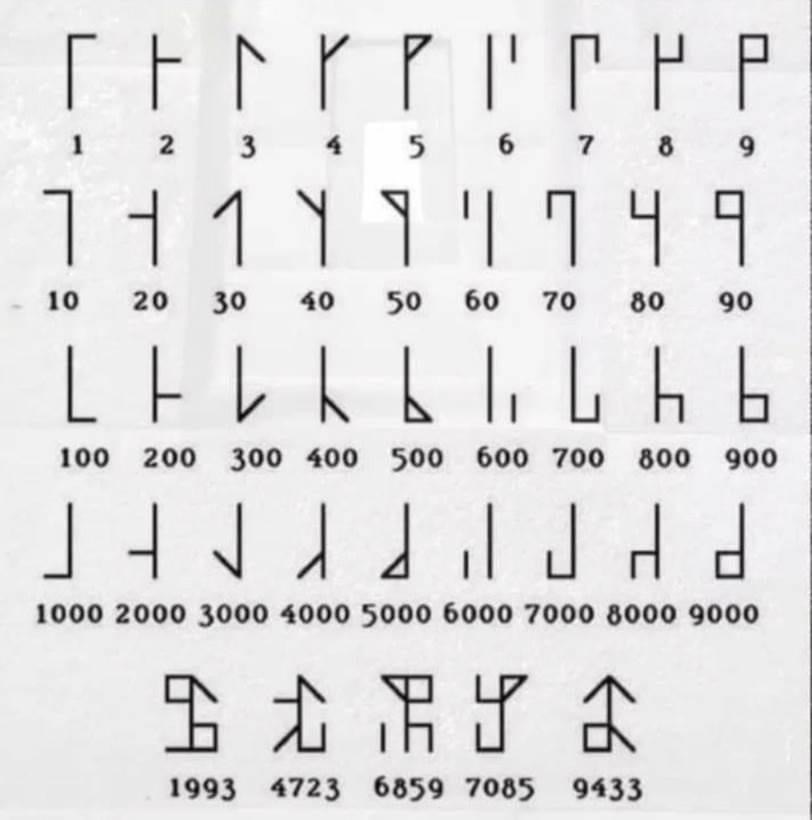
The chroniclers of Iorth, ever since the initial days of prehistory, created a unique system of coding the years using a special set of glyphs, as shown here. This method allowed for a compressed and consistent expression of a numerical value from 1 to 9,999.
This method is still used by chroniclers to this day, and it is the official means of recording years on graves, monuments, and other official scripture.

Ritual Divinatory Objects of Iorth

While the items used to divine the unknown may be well-known, there are some aspects which are not commonly known to the layfolk of Iorth. In any event, these items, when used in stationary rituals, reveal aspects about the diviner and divination method in use.

  • Bones: Originally used with the various collecting and scattering of actual bones, this method now refers to the use of specially prepared long bones or carved long bone fragments either scattered and reviewed, or having involved subjects draw lots. One common practice with orc and goblin diviners includes inscribing the letters of the Orcish abjad on the bones, adding a runecasting-like element to the method.
  • Cards: Card-based divination occurs commonly using ordinary playing cards, though there are some dedicated decks of cards and methods used solely for divination.
    • There is the non-native tarokka deck, brought over to Iorth by extraplanar adventurers during Year Zero.
    • Then there is the dalykas deck, consisting of 56 cards: 22 are in the high deck, and the other 34 are in the low deck. These cards are usually treated with reverance and caution, since the high deck cards are the same as those used in the infamous deck of many things, whereas the low deck cards are used in the deck of illusions.
    • Finally, there is the “common” sport deck, consisting of 52 cards divided into 4 suits: coins (yellow circles), points (red triangles), blocks (green squares), and stars (blue stars). The “royalty” of each suit consists of the lord, lady, and herald. The correspondence of the 52 cards to the 52 weeks of the year, with 4 suits mirroring the 4 seasons, adds new dimensions to this scrying method.
  • Coins: The common method of scrying with this method is the simple coin flip, often done with a common coin (a higher denomination for a more important inquiry). However, there are methods using the more rarely-circulated coins of the realm. With the non-round coins, the orientation as well as facing of the cast coin or coins come into consideration of the reading. A bronze coin, with its pierced center, can be auspicious if it lands on an object and frames an image or feature on what lies beneath it. Yet, the premier method used by devoted coin diviners is using one or a set of rose gold triangular coins.
  • Crystals: Typically thought of in the form of crystal spheres around the approximate size of an individual’s head by most, in actuality many of these objects are small and easily held or concealed in one hand. In addition, unique naturally-formed crystals, especially unique crystal formations or clusters, are also used in this process. Rock crystal is the preferred material of choice, though other types of precious stone may be used.
  • Dice: While common diviners use the standard game dice (tetrahedron, cube, and dodecahedron) for a method of scrying, the serious and devoted students of the art use either a set of octohedral sigil-inscribed dice, or a single sigil-inscribed isocahedral die, often of rare bone, petrified wood, or precious stone. Since facets of these dice are triangles, the triangle pattern has added significance to the reading of cast multiple dice. In some instances, the sigils on a die are divided up into even “sets” and colored red, yellow, green, and blue, much like cards.
  • Dominoes: This method uses the standard double-six gaming set of dominoes, drawn randomly and placed within a particular pattern. This can involve a “quick read,” using only a limited number of tiles, or a “whole read,” which uses the entire set. Some diviners opt to study ongoing domino games for their readings, since the drawing and placing of tiles is out of their hands.
  • Formreading: This method requires a subject, and involves intense examination of a highly-featured appendage, such as a palm of the hand or sole of the foot. This can also be done by studying the details of a subject’s eye (such as the clarity or blemishing of the sclera and iris).
  • Mirrorgazing: Typically, a small mirror or mirror-like surface can suffice for the practice, though devout practitioners will use finely-crafted items made of quality materials.
  • Poolgazing: This method involves a still pool of water, whether in a natural source, or contained within a cup, chalice, bowl, or cauldron.
  • Runes: The drawing or casting of runes, typically using the Giant alphabet, is a common divination method used by dwarves.
  • Stargazing: Astrological observations are one of the oldest and well-established methods of divination used by multiple cultures in Iorth. The movement of the seven planets (all visible to the naked eye), constellations, comets, meteor showers, novas, as well as of other visible phenomena, play a significant role in the scrying method.

Random Miscellany of Iorth (the 1st)

This post feature will cover a diverse array of topics, rather than a particularly curated category of material, such as nations, organizations, creatures, and so on. But, with this electronic format and the brief shelf life of content on timelines, I will do my best to include tags to ease finding certain bits of material again.

—the Earthly Wordsmith

From the annotations and drafts of Alder the Scribe…

Currency of Iorth

Due to the strong influence of the former Great Empire, as well as the institutionalization and backing of the Coin Guild of in the gnomish city-state of Zurik, all nations in the world of Iorth use and mint the same type of tri-metal decimary currency system. Though each currency may bear different obverse and reverse designs on their coins, the size, weight, and shape of the coins, as well as their metal content, is universal. Since the fall of the Great Empire, this monetary system has been kept due to the familiarity and trustworthiness it holds with the populace.

Due to refined minting by dwarves and gnomes, the average size of a coin is respectably small: each circular coin is approximately an inch in diameter. The coins are such that 50 coins of mixed value weigh a single pound. Each coin is circular, and the reverse is struck with the hallmark of the Coin Guild, along with the Primordial runic initial for the metal of the coin. The obverse originally held the image of the ruling High King during the time of the Great Empire, but now it holds a star along with the first initial of the guildhouse where the coin was struck. The Coin Guild assures the metal quality and content of every coin it strikes.

The standard coins of circulation are as follows:

  • The copper penny, which is the lowest denomination currency of the realms. It has a smooth edge.
  • The silver shilling, worth 10 pence and is the most commonly used currency of the realms. It has a reeded edge.
  • The gold crown, worth 10 shillings (or 100 pence) and the highest value common currency of the realms It has a diamond knurled edge. 

Furthermore, there are special commemorative coins created by the Coin Guild that are not as frequently seen, but are still regarded as legal tender. Unlike standard coins, these coins bear only the hallmark of the Coin Guild on the reverse, and bear a special scene or portrait of a nation’s sovereign (left-facing for coins struck after a sovereign’s death, and right-facing for coins during a sovereign’s reign). These coins are:

  • The bronze farthing, worth 5 pence. It has a smooth edge and a round central hole.
  • The electrum guilder, worth 5 shillings (or 50 pence). It has a reeded edge and is square in shape.
  • The palladium rupee, worth 5 crowns (or 50 shillings, or 500 pence). It has a reeded edge and is hexagonal in shape.
  • The platinum dollar, worth 10 crowns (or 100 shillings, or 1,000 pence). It has a diamond knurled edge and is octagonal in shape.

Though in some instances the value of a coin is expressed by its full name, typically the expression of currency value in merchant notation makes the use of numerals proceeded by the currency sign (‡), with periods used for decimal place markers of fractional values and commas used as decimal place markers of thousands whole values. So, using merchant notation, a monetary value of 3 gold pieces, 4 silver pieces, 5 copper pieces would be written as thus: ‡3.45

The Common Languages of Iorth

Though there are several languages throughout Iorth, there are only a relative handful of widely-spoken languages that can be encountered. Due to the powerful and vast influence of the Great Empire during its reign, Common has become the base language of almost all humans in Iorth, and it is used as the language of diplomacy and trade throughout Iorth. Some languages have been adopted for use beyond communication by native speakers.

LanguageTypical Native SpeakersScript
CelestialCelestials, angelkinCelestial
CommonHumansCommon
*HalflingHalflingsCommon
**Thieves’ CantRogues
DraconicDragons, lizardfolkDraconic
GiantOgres, giantsDwarvish
*DwarvishDwarvesDwarvish
AbyssalDemons, yugolothsInfernal
*GnollGnolls
*Deep SpeechAboleths, cloakers
*InfernalDevils, devilkinInfernal
*MinotaurMinotaursInfernal
OrcOrcsOrcish
*GoblinGoblinoidsOrcish
PrimordialElementalsPrimordial
*AquanWater elementalsPrimordial
*AuranAir elementalsPrimordial
*IgnanFire elementalsPrimordial
*TerranEarth elementalsPrimordial
Druidic DruidsDruidic
SylvanFey creaturesElvish
*ElvishElvesElvish
**GnomishGnomesElvish
UndercommonTroglodytesTrog
VeslishWesterner nobilityVeslish
EstlishEasterner courtiersEstlish
SudlishSoutherner tradersSudlish
NorlishNortherner shamansNorlish
The common languages of Iorth
Languages listed in italics are parent languages to asterisked entries
Languages listed in bold are hybrid languages
*Language originally descended from the above-mentioned entry

The major scripts used in Iorth include:

  • Celestial: A simple, accurate, effective, and clear phonetic alphabet. Often used for religious purposes by followers of the Path of Light.
  • Common: A simple phonetic alphabet created during the rise of the Great Kingdom. It took lessons from existing scripts and languages and purposefully avoided creating digraph (like ch or th) glyphs for each phoneme of the language. There is also manual and tactile versions of Common.
  • Draconic: An exhaustive logographic script.
  • Dwarvish: A precise runic alphabet. The original script used for the Giant language included diacritics, though the use of the script for Dwarvish only uses the diacritics for important ceremonial uses, and abandons them for everyday use. Dwarvish also has a tap code version of the script.
  • Elvish: A flowing complex phonetic alphabet, with print and cursive forms, as well as a ceremonial Ogham-like form.
  • Infernal: A complex and difficult abugida that heavily uses diacritics made for the Infernal version of Abyssal. The near-similarities of glyphs and diacritics make decoding mistakes rampant, even for skilled speakers, readers, and writers of the script and language. Often used for religious purposes by followers of the Path of Darkness.
  • Orcish: A true abjad script written in reverse boustrophedonic fashion. Primarily used for inscriptions on objects, but has been adapted for use in texts.
  • Primordial: An ideographic script, and the oldest script in Iorth, used with the oldest language in Iorth.

Rarer scripts encountered in Iorth include:

  • Druidic: A rare combination logosyllabic and alphabetic script derived from both Primordial and Sylvan, and used exclusively by druids. It was purpose-made to be easy to carve into material such as wood or stone. Druidic also has a whistled language.
  • Estlish: An abugida script with several diacritics used by the peoples of the Estlands.
  • Norlish: A runic alphabet used by the peoples of the Norlands.
  • Sudlish: An abjad used by the peoples of the Sudlands.
  • Trog: Unlike the other scripts mentioned, the Trog writing system is a tactile cuneiformic abjad written in boustrophedonic (winding) and stoichedonic (gridded) patterns, meant for use in the total darkness of the Nether Lands. There is also a tap code version of the script. It is a combination language fusing elements of Elvish and Dwarvish into a core descendant of Abyssal.
  • Veslish: A syllabary script used by the peoples of the Veslands.

Link to the Radiant Citadel

Recently there have been reports that a rediscovery of a lost extraplanar conveyance known as a Concord Jewel recently occurred. Per reports of the encounter, the Concord Jewel and its passengers have not been to Iorth since the days of prehistory. These passengers also speak of a guardian of Iorthling cultures, known as a Dawn Incarnate, which resides within a structure deep within the Ethereal Plane known as the Radiant Citadel.

As reported before their latest departure, the Black Opal is the Concord Jewel of Iorth. The Dawn Incarnate of Iorth is said to manifest as a powerful Black Opal Lynx.