There is a fine line between the mundane and the magical, even in a magical world such as Iorth. Seemingly everyday items have deeper and more significant aspects than some realize.
Recording Years in Iorth
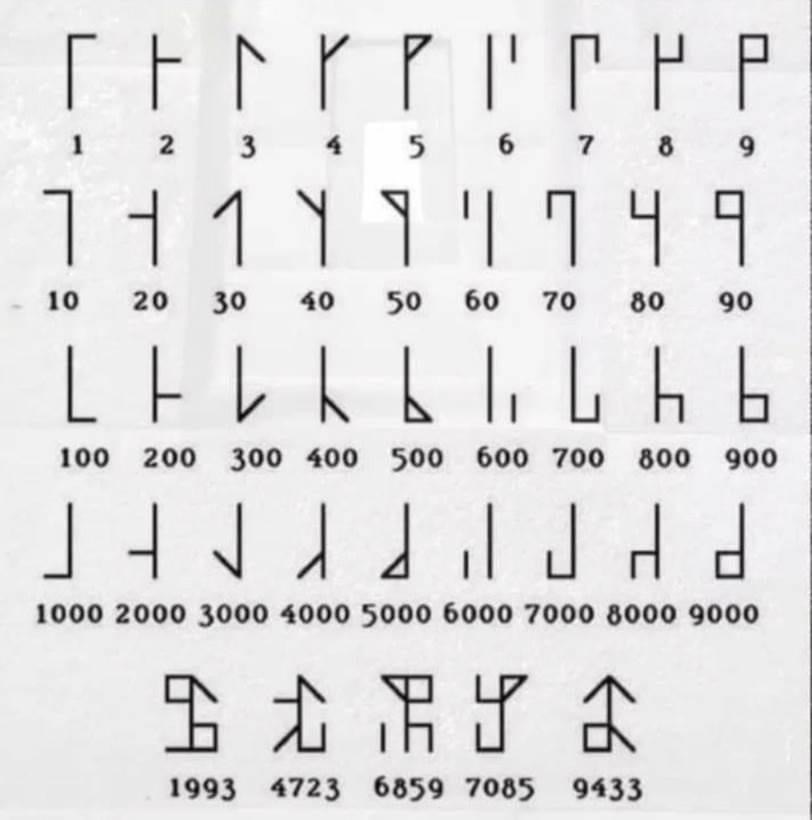
The chroniclers of Iorth, ever since the initial days of prehistory, created a unique system of coding the years using a special set of glyphs, as shown here. This method allowed for a compressed and consistent expression of a numerical value from 1 to 9,999.
This method is still used by chroniclers to this day, and it is the official means of recording years on graves, monuments, and other official scripture.
Ritual Divinatory Objects of Iorth
While the items used to divine the unknown may be well-known, there are some aspects which are not commonly known to the layfolk of Iorth. In any event, these items, when used in stationary rituals, reveal aspects about the diviner and divination method in use.
- Bones: Originally used with the various collecting and scattering of actual bones, this method now refers to the use of specially prepared long bones or carved long bone fragments either scattered and reviewed, or having involved subjects draw lots. One common practice with orc and goblin diviners includes inscribing the letters of the Orcish abjad on the bones, adding a runecasting-like element to the method.
- Cards: Card-based divination occurs commonly using ordinary playing cards, though there are some dedicated decks of cards and methods used solely for divination.
- There is the non-native tarokka deck, brought over to Iorth by extraplanar adventurers during Year Zero.
- Then there is the dalykas deck, consisting of 56 cards: 22 are in the high deck, and the other 34 are in the low deck. These cards are usually treated with reverance and caution, since the high deck cards are the same as those used in the infamous deck of many things, whereas the low deck cards are used in the deck of illusions.
- Finally, there is the “common” sport deck, consisting of 52 cards divided into 4 suits: coins (yellow circles), points (red triangles), blocks (green squares), and stars (blue stars). The “royalty” of each suit consists of the lord, lady, and herald. The correspondence of the 52 cards to the 52 weeks of the year, with 4 suits mirroring the 4 seasons, adds new dimensions to this scrying method.
- Coins: The common method of scrying with this method is the simple coin flip, often done with a common coin (a higher denomination for a more important inquiry). However, there are methods using the more rarely-circulated coins of the realm. With the non-round coins, the orientation as well as facing of the cast coin or coins come into consideration of the reading. A bronze coin, with its pierced center, can be auspicious if it lands on an object and frames an image or feature on what lies beneath it. Yet, the premier method used by devoted coin diviners is using one or a set of rose gold triangular coins.
- Crystals: Typically thought of in the form of crystal spheres around the approximate size of an individual’s head by most, in actuality many of these objects are small and easily held or concealed in one hand. In addition, unique naturally-formed crystals, especially unique crystal formations or clusters, are also used in this process. Rock crystal is the preferred material of choice, though other types of precious stone may be used.
- Dice: While common diviners use the standard game dice (tetrahedron, cube, and dodecahedron) for a method of scrying, the serious and devoted students of the art use either a set of octohedral sigil-inscribed dice, or a single sigil-inscribed isocahedral die, often of rare bone, petrified wood, or precious stone. Since facets of these dice are triangles, the triangle pattern has added significance to the reading of cast multiple dice. In some instances, the sigils on a die are divided up into even “sets” and colored red, yellow, green, and blue, much like cards.
- Dominoes: This method uses the standard double-six gaming set of dominoes, drawn randomly and placed within a particular pattern. This can involve a “quick read,” using only a limited number of tiles, or a “whole read,” which uses the entire set. Some diviners opt to study ongoing domino games for their readings, since the drawing and placing of tiles is out of their hands.
- Formreading: This method requires a subject, and involves intense examination of a highly-featured appendage, such as a palm of the hand or sole of the foot. This can also be done by studying the details of a subject’s eye (such as the clarity or blemishing of the sclera and iris).
- Mirrorgazing: Typically, a small mirror or mirror-like surface can suffice for the practice, though devout practitioners will use finely-crafted items made of quality materials.
- Poolgazing: This method involves a still pool of water, whether in a natural source, or contained within a cup, chalice, bowl, or cauldron.
- Runes: The drawing or casting of runes, typically using the Giant alphabet, is a common divination method used by dwarves.
- Stargazing: Astrological observations are one of the oldest and well-established methods of divination used by multiple cultures in Iorth. The movement of the seven planets (all visible to the naked eye), constellations, comets, meteor showers, novas, as well as of other visible phenomena, play a significant role in the scrying method.
 Iorthbound